
First index report free (limit to 100 pages)

Get alerted when important pages drop out of Google.

A page can drop out of Google and you may only find out when traffic falls. BoastIndex watches your important URLs, tracks Search Console index status over time, and turns status changes into alerts and index status reports.

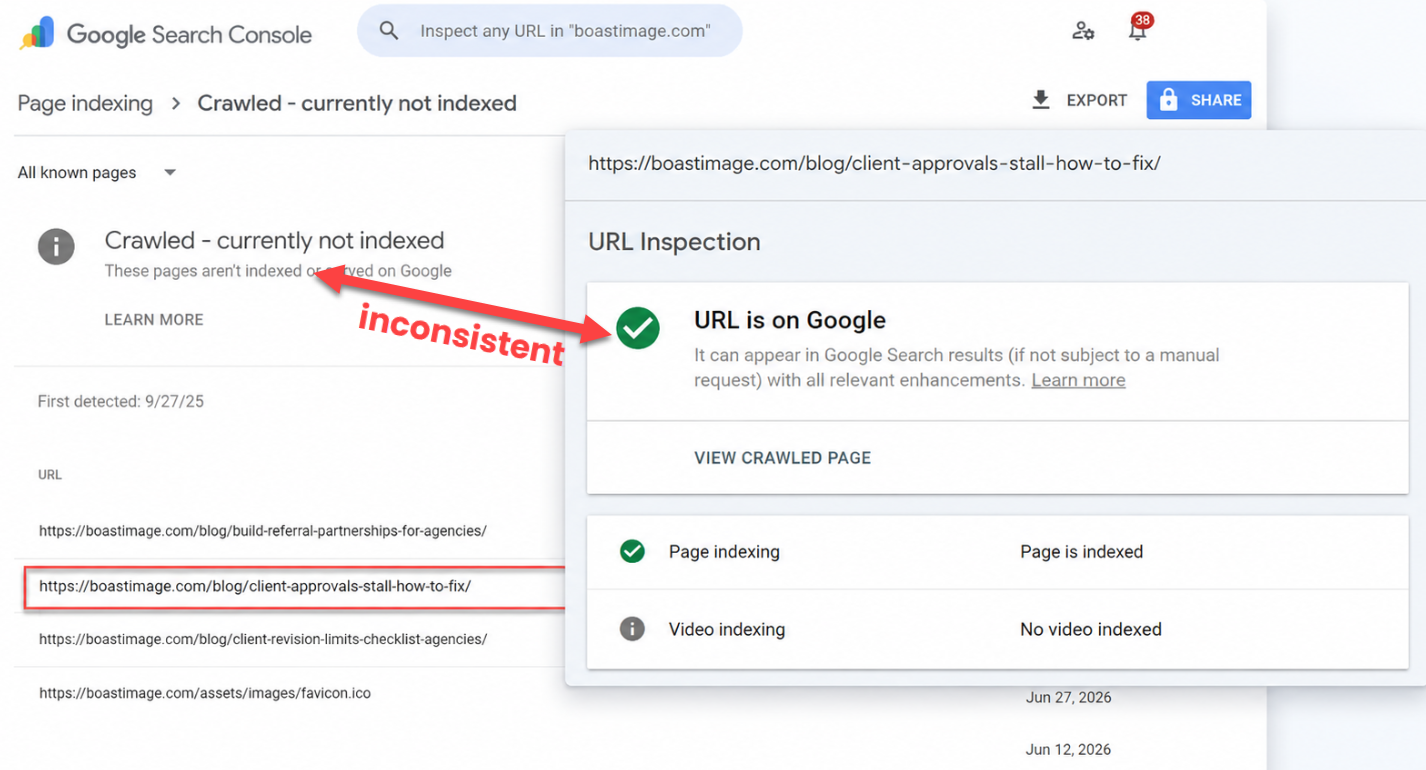
GSC does not always agree with itself

Index status can be confusing, inconsistent, and hard to track over time.

Page Indexing, URL Inspection, live tests, canonical URLs, and historical data can each report a different answer for the same page. One view says the URL is on Google. Another says crawled, currently not indexed. BoastIndex keeps a record of URL index status over time, so you can see whether a page is improving, getting worse, or quietly falling out of Google before traffic is the first warning sign.

Google Search Console indexing mismatch showing crawled currently not indexed and URL is on Google
Same URL, conflicting GSC signals. BoastIndex tracks which status changed over time.

Why trust the data?

BoastIndex reports what Google Search Console reports. Here is how the data path works.

Read-only Search Console access

BoastIndex connects to your Google Search Console property with read-only access. It does not change site settings or request indexing.

What is stored

BoastIndex stores the URLs you choose to monitor and the inspection history for those URLs: status, timestamps, and changes over time.

Inspection cadence you control

You choose how often important URLs are inspected. Scheduling stays quota-aware so checks fit within Search Console limits.

What BoastIndex does not claim

BoastIndex does not request indexing and does not replace Google's verdict. It records and surfaces the index status Google already reports.

Google indexing statuses BoastIndex monitors

Track the Search Console statuses that usually send teams digging through reports, exports, and one-off URL inspections.

From one-off URL inspection to recurring monitoring

Google's URL Inspection tool is useful for spot checks. It is painful for ongoing URL index monitoring. BoastIndex lets you import important URLs, choose an inspection cadence, and keep watching for index status changes automatically.

Connect GSC → Import URLs → Choose cadence → Monitor changes → Report

1 · Connect GSC

Connect your Google Search Console property with read-only access.

2 · Import URLs

Add pages by sitemap, CSV, pasted list, or manual entry.

3 · Choose cadence

Run monthly, weekly, or daily URL inspections with quota-aware scheduling.

4 · Act on changes

Get alerts and index status reports when important URLs change status.

Catch index changes before they become traffic mysteries

A one-time check tells you what Google reports right now. BoastIndex keeps the history, highlights URLs that changed, and helps you investigate before the first clue is a traffic drop.

Discovered Crawled, not indexed Indexed
Indexed Not indexed Needs review
Noindex Fixed Indexed

Simple pricing

Simple pricing for one-time reports and recurring monitoring

Start with a one-time index report, or choose recurring monitoring so you hear about index drops before traffic does. Pricing scales by URL count and inspection frequency.

  • First one-time report is free. After that, reports start at $15.
  • Yearly monitoring starts at $150/year (less than $0.50 a day, billed annually).
  • Pricing scales by tracked URLs and inspection frequency.

FAQ

Common questions

What is Google index status monitoring?

Google index status monitoring tracks whether Google reports your important URLs as indexed, not indexed, or in another Search Console coverage state, and records those results over time. The goal is to catch status changes, send alerts, and produce index status reports instead of relying on one-off Search Console checks. BoastIndex automates scheduled URL inspections and keeps that history in one place.

Can indexed pages drop out of Google?

Yes. A page that was indexed can later become not indexed if Google stops including it in the index. Common causes include a noindex tag, a canonical change, crawl or access problems, quality signals, or other indexing decisions. Index status monitoring helps detect those drops when Search Console reports the change.

How do I know when an important page is no longer indexed?

Recheck the URL in Google Search Console URL Inspection or Page Indexing, then compare the result with earlier checks. Search Console does not alert you when a page moves from indexed to not indexed, so one-off checks often miss changes between visits. BoastIndex monitors important URLs on a schedule and alerts you when index status changes.

Does Google Search Console alert you when a page changes from indexed to not indexed?

No. Google Search Console does not send realtime alerts when a specific URL changes from indexed to not indexed. You usually find out only if you inspect the URL again, review Page Indexing reports, or notice traffic loss. BoastIndex adds recurring URL-level monitoring and change alerts on top of Search Console data.

Why can indexing problems hurt traffic before you notice them?

Organic traffic depends on pages remaining eligible to appear in Google search results. If an important URL drops out of the index or stays stuck as not indexed, impressions and clicks can fall before anyone opens Search Console. Without scheduled monitoring and alerts, teams often discover the problem after rankings or revenue already moved.

How is BoastIndex different from Google Search Console?

Google Search Console is the source of the indexing data. BoastIndex turns that data into ongoing URL monitoring, status history, alerts, and index status reports so teams can see what changed and which URLs need attention.

Why does Google Search Console show different indexing statuses in different places?

Search Console pulls from different views, including Page Indexing aggregates, URL Inspection, live tests, canonical signals, and historical snapshots, and those views do not always match. BoastIndex tracks URL-level inspection results over time so you can compare what changed instead of relying on one isolated check.

How often should important URLs be checked for indexing changes?

It depends on how fast your site changes and how critical the URLs are. High-value pages often need daily or weekly checks. More stable URLs may only need monthly monitoring. BoastIndex supports monthly, weekly, or daily URL inspections with quota-aware scheduling so you can match cadence to URL importance.

Does BoastIndex request indexing or submit pages to Google?

No. BoastIndex does not request indexing, submit pages to Google, or try to force Google to crawl a URL. It monitors what Google reports, tracks index status changes over time, and helps identify URLs that need review.

What is included in an index status report?

An index status report shows which URLs were checked, which pages are indexed or not indexed, what changed since the last inspection, and which URLs may need review.

Do not wait for traffic to tell you a page dropped out of Google.

Get alerts when important URLs move to not indexed, so a quiet drop does not become a traffic surprise.